Bunny’s encounter at Mary Armstrong’s bungalow
The Death of Bunny MunroBunny’s encounter at Mary Armstrong’s bungalow turns an attempted sales visit into a crisis that exposes the gulf between his salesmanship and the consequences of his actions. The neglected house becomes the setting for a disturbing encounter, followed by an abrupt attack and a split-second moment of danger involving Bunny Junior.
Arrival and Discovery
Bunny approaches the bungalow along an oil-splattered drive, empties his Scotch flask, and knocks at the door. When it opens to an apparently empty house, he calls for Mary Armstrong and steps inside. The property’s overgrown yard, scattered rubbish, grimy walls, and shattered windows make the place feel abandoned before he has met anyone there. In a dim room at the end of the hall, a guitar amplifier feeds back beneath a bare bulb. A very thin young woman sits almost motionless on a ruined settee. When Bunny asks for Mary, she says Mary no longer lives there and asks whether he wants to see Mushroom Dave.
Recognition and Violation
Bunny switches off the guitar amplifier, silencing the feedback, and approaches the young woman. Her condition is extreme: she can barely lift her eyelids, appears profoundly frail, and has signs of recent drug use nearby. Bunny notices that a poster on the door, which he had taken for an image of Avril Lavigne, actually depicts the woman herself. He treats the resemblance as more than coincidence, investing it with a supernatural significance that the narration associates with his damaged grief and desire.
Rather than respond to the woman’s vulnerability as a reason to withdraw, Bunny handles her and sexually assaults her while she is gravely impaired and unable to give meaningful consent. The scene makes the gap between his self-image and his conduct stark: he enters as a salesman, but his attention to the woman becomes an act of exploitation. The poster’s idealized image and the living person before him collapse together in Bunny’s perception, while her critical condition remains unmistakable.
Attack and Flight
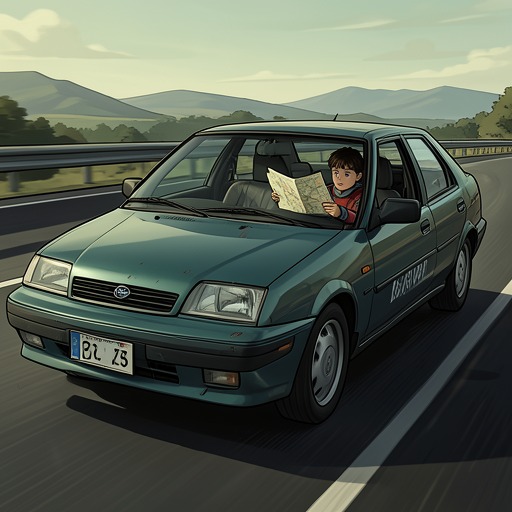
The young woman’s acquaintance, Mushroom Dave, bursts out of the house wielding a golf club and pursues Bunny. The attempted visit has become an immediate threat: Bunny reaches the yellow Fiat Punto as Mushroom Dave swings at it, shattering a side window. In the confusion, Bunny discovers that Bunny Junior is not in the car. He starts the engine and accelerates away just as his son appears in the street, directly in the car’s path.
Bunny brakes in time to stop. For a moment, father and son look at one another without speaking, and the narration presents their shared recognition of shame, terror, and death as an obscure intimacy. The encounter thus ends not with Bunny’s escape alone but with his son suddenly placed inside its danger: the salesman’s flight from the bungalow has brought the crisis to the edge of a potentially fatal collision between them.
The Child Outside the Crisis
While Bunny is inside the bungalow, Bunny Junior waits outside with his Darth Vader figurine, carrying the recent reassurance of his mother’s apparition: he feels protected by her and believes her presence can guard him in a way that real people cannot. That conviction gives the boy’s absence from the room a quiet emotional weight; he is not simply out of sight, but holding on to a bond that steadies him amid the adults’ disorder.
Bunny Junior also knows that his father is lost and falls short of the fathers he has seen elsewhere, yet loves him without reservation. His faith in Bunny is therefore set against the danger Bunny’s actions have created. When the boy finally appears in the Punto’s path, the encounter’s threat reaches beyond Bunny’s escape and becomes a test of the fragile attachment that has kept his son beside him.